
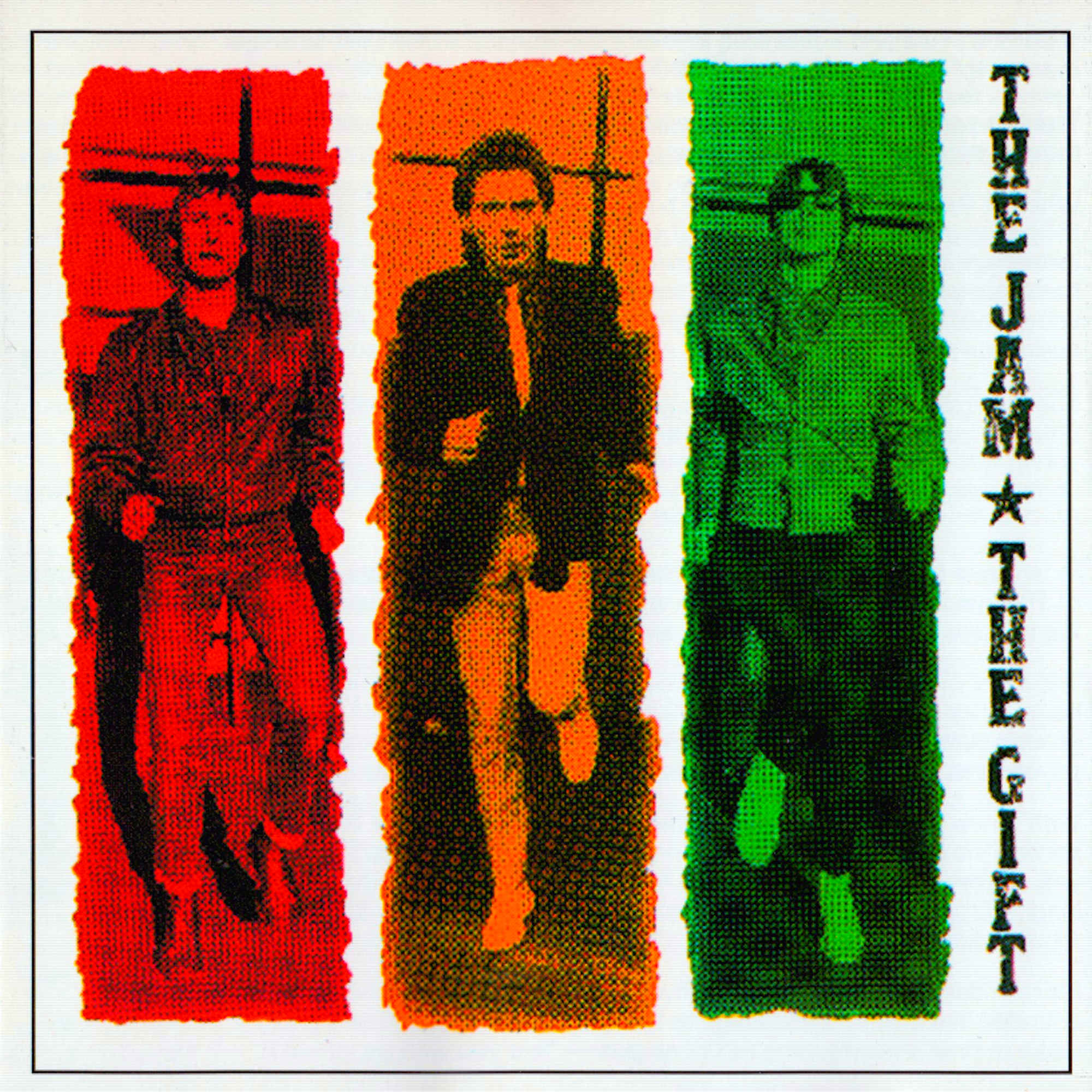
The Gift
tracks on LP: Happy Together / Ghosts / Precious / Just Who Is The 5 O’ Clock Hero / Trans-Global Express / Running On The Spot / Circus / The Planner’s Dream Goes Wrong / Carnation / Town Called Malice / The Gift
Polydor POLD 5055
Producer: Peter Wilson
Released: 12/03/82
Purchased: blagged a copy on tape, 1982
My story with ‘The Gift’
We all had a favourite band when we were teenagers and still at school right? Well, my fan worship was aimed at The Jam. I bought their records, I bought their merchandise, I had Jam posters on my bedroom wall and I went to their gigs whenever they came to Newcastle.
My support for them waned from around the time they released the trumpet noise of “Absolute Begginers”, I was never much into anything they released after that one either although, like most fans, probably still bought their records out loyalty.
But it got to the point where I even stopped wasting my pocket money on their records. I never got around to buying “The Gift” when it was released during March 1982.
I heard a few tracks on the radio and of course a “Town Called Malice” was on “The Gift” but . . . . no, not my scene. I didn’t want to listen to all of the funky gibberish like “Precious”, “Trans-Global Express” or that crappy calypso bollocks “The Planner’s Dream Goes Wrong”.
Almost forty years later I decided to shell-out £3 for the CD. What had I missed? I knew that “Carnation” was created with the familiar Jam sound (similar to the soundscapes “Sound Affects”) and reminded me of another Weller love song “English Rose” from “All Mod Cons”.
There’s nothing else to gain my admiration on this. Sounds like Level 42 meets the Fun Boy Three or some other tedious crap like that. I’m even horrified that Bruce Foxton appears to sound like he’s ‘slapping’ his bass strings on a few numbers. Rick Buckler’s drum action is still magnificent.

Kitchen-sink realism
THE JAM: ‘The Gift’ (Polydor POLO 5055) **** AFTER A year and a half In the desert, the three wise men return — ‘The Gift’ in tow. Brows furrowed with care and concern, the Jam call the new pop’s bluff, proving that prettiness is no substitute for joy. They insist on calling Tinseltown by Its proper name: Wasteland.
Fresh-faced “Innocents” – may come and go but Paul Weller, at 23, is the elder spokesman of British youth. On ‘The Gift” Weller assumes his duties with a mixture of earnest philosophising and jaunty, bouncing beat. Long live love!
Love in the face of despair
Weller has always swung between the nihilism of punk and the dreamy idealism of a sixties adolescence. The best Jam songs mix an angry kitchen-sink realism with a surging desire for change. Weller’s angry at the way things are but, up to now, unable to see any solutions that aren’t either glib or unlikely.
On ‘The Gift’. he finally steps off the fence and goes for love in the face of despair and intelligence in the place of exhaustion.
Musically, ‘The Gift’ moves right over to Motown, mixing a touch of calypso (on ‘The Planners Dream Goes Wrong’) and a touch of ‘Shaft’-like disco on ‘Precious’) with a basic soul strut. The old Jam multi-layered guitars are here, along with the harmonies and the familiar punch, yet the musical range of ‘The Gift’ is wider than ever and the Jam’s skills more developed.
Familiar Jam touches abound. Mini-moral operas like ‘Ghosts’, which uses the melodic rifting style of ‘Mr Clean’ and more standard Jam work-outs like ‘Just Who Is The Five O’ Clock Hero?’ on the first side, and ‘Carnation’ on the second. The Jam have retained their identity while enlarging it to include ringing brass work and best of all, a bubbly happiness that rings though the album.
Weller’s understanding of dole-queue despair is equalled by his insistence on the value of the secret of the beat. ‘The Gift’ is determined to put joy back In the town called Malice and brings ghosts back to their senses. On ‘Ghosts’ itself, Weller affirms the importance of loving insisting that “old fashioned causes like that still stand”
The Jam are art institution

The slightly apologetic tone isn’t necessary: Weller has no need to be intimidated by the triteness of recent fashions. Yet, in his role as elder spokesman, I suspect he fears the problems raised by the Jam’s superiority. The Jam are art institution and their isolation (who else has survived since 77, morally intact?) could always turn them into a dinosaur.
The major dinosaur tendency on ‘The Gift’ is Weller’s leanings to rather awkward and abstract lyrics. Lines like: ‘We’re the next generation of the emotionally crippled’ hardly bounce along.
And Weller’s newly assumed role as spokesman too often leads him into the silly generalisation. The album’s worst track, the messy ‘Trans-Global Express’ has Weller on the outside looking in, substituting sweeping statements for the Jam’s usual faith, their ordinary, biting anger. Such are the dangers of isolation.
Still, for the most part, Weller and Co keep their integrity by finding glamour no substitute for “truth”. Weller’s earnest concern and occasional lyricism finds its perfect counterpart in the springing joy of sixties’ soul and, yes, the Jam have done it again! Thanks for ‘The Gift’. (Record Mirror, 06/03/82)

Weller: Where There’s A Will But No Way
‘The Gift’ is The Jam’s ball of confusion. Though its purpose is laudable – to stir up a defiant dance step at the heart of the Tory wastelands – it’s undermined by a failure to balance style and, beyond these uncertainties of stance that this projected fight-back throws up.
The conflicting pressures that determine this gameplan are wryly acknowledged on the LP cover: while the title urges “keep on movin’”, the sleeve pics of the band refer to another song, “Running On The Spot”.
If this suggests The Jam realise the question facing them is ‘move to where?’, ‘The Gift’s floundering after direction reveals their current lack of answers. What this record misses most is the cohesion and coherence of its predecessors.
The inspiration which fired ‘All Mod Cons’ and ‘Setting Sons’ has either dried up or been discarded. With hindsight, the first inkling of The Jam’s discontent probably came in the way ‘Sound Affects’ tailed off on its second side. The weaknesses that then seemed due to haste or lapses into indulgence now look as if they sprung from a deeper restlessness.
In the 18 months since that LP, The Jam have changed producers, switched studios, experimented with horns – while their singles have taken an increasingly bleak political slant.
The tensions on which their records fed so brilliantly have, on ‘The Gift’, been pushed into unrecognisable extremes. It’s an LP riven by frustration, steeped more in the fierce anguish of “Running On The Spot” then – that polarity again – the laboured positivism of the title-track.
“Running On The Spot”, which opens side two, is a key track. musically, it’s standard Jam fare and, like the other ‘typical’ Jam tracks here, comes across a little predictable, a little stale (especially when it rehashes that “baba baba” vocal break from both “David Watts” and “Man In The Corner Shop”).

The Jam | The Gift | Polydor | 1982
But it’s the lyrics that matter most. A staight confession of Paul Weller’s desperation – “I was hoping we’d make real progress / but it seems we have lost the power . . . We’re running on the spot – always have – always will? / We’re just the next generation of the emotionally crippled” – suddenly switches into a bitter attack on his audience. “Out in the pastures we call society / You can’t see further than the bottom of your glass . . . Just like sheep – little lambs into the slaughter / Don’t fully grasp what is exactly wrong – truth is you never cared . . . “
This tangled rant hits home with more feeling than the standard “keep movin’” exhortations of the title-track, but Weller’s most effective lyrics have always taken a more detached view of his obsessions – “Pretty Green” or “Burning Sky” as subtle as comments on corrupting materialism pack far more punch than the bold denunciations of “Scrape Away”, which shares with “Running On The Spot” a kind of surrender to its own botheredness.
The undercurrents that before were held together are now falling apart. Weller wants to be optimistic , but not escapist; he distrusts politics, but is drawn to political affairs (and can find little reason there to be optimistic), he seems tired of the old-style Jam music, rooted in ’60s pop and soul, but knows of no better alternative, so ends up dabbling.
On two tracks, this dabbling ends up in fiasco. “The Planner’s Dream Goes Wrong” proceeds as if the horns and steels drums had been told it was a calypso while the rest of the band had been assured it wasn’t. The ensuing melee is so painful you could even forget to wonder why The Jam are protesting about high-rise flats years after they’ve gone on of favour.
Stranger still comes on “Trans Global Express”. Lyrically, this is the most radical statement The Jam have made, and its importance is emphasised on the inner sleeve where it’s placed apart from the other lyrics: “Imagine if tomorrow the workers went on strike / Not just British Leyland but the whole world / Who would earn their profits? / Who would make their bombs? / You’d see the hands of oppression fumble / And their systems crash to the ground.”
I suspect it’s less a conversion to Marxism than an update of the Shelley poem which appeared on the ‘Sound Affect’ sleeve, but it’s all right-on stuff. Hoe weird then that the lyrics are mixed so low they are practically inaudible, that what sounds like a potentially great song is drowned in an excess of production tricks, electronic noises and jokey vocal bits. Coyness? Failure of nerve? I can’t even guess.
The Jam | The Gift | Polydor | 1982
It’s curious how Weller’s political ideas, just like his music, can be traced back to the ’60s. The dream of imminent worldwide revoltion seems redolent of that era, as does his insistence on the saving power of love: “. . . spread some loving all around / old fashioned causes like that still stand” (“Ghosts”). This is a very ’67 notion. However intoxicating or revelatory of consoling or (after feminism) problematical love may be, I’d have thought the one thing the failure of the hippie movement had established was that it didn’t work as “a cause”.
The obverse of this comes on “Carnation” and passim – where Greed, Fear and Hate are identified as The Enemy. Sadly, the complexities and rich social detail that went into ‘All Mod Cons’ and ‘Setting Sons’ have largely been ditched in favour of such abstract simplications.
The one exception to this, and to all my critisms of ‘The Gift’, is “Town Called Malice”, a magnificent howl of outrage at Thatcherite Britain. The LP cut makes its debt to Motown even clearer than the live 12″, an echo of heatwaves and boom years that adds a startling poignancy to its icy depiction of current hardships.
I like “Precious” for Weller’s great singing, though it drags when it tries to become a funk workout. (stick with soul, Paul). “Ghosts” is delicate and sensitive. “Circus” an artful instrumental that recalls those US TC cop show themes of the ’60s.
“Happy Together”, the opening track, is all bristling guitar action, almost vintage Jam but for a mundane lyric, while “Just Who Is The Five O’ Clock Hero” is another Weller vignette of lower middle class life – it’s OK, but it’s been done better before, usually by The Jam.
What else? The horns, used sparingly, work well as decoration (shades of George Martin and The Beatles?) but flop when they’re given a more central role, as on “Precious”. Keyboards are more to the fore, and the LP is looser, liver feel than previous Jam albums.
The Jam | The Gift | Polydor | 1982
On ‘The Gift’, which closes the record, this live feel is rather forced as Weller tries to rewrite “Non-Stop Dancing” as a heavy philosophical statement – the whistles, cries, and murky sound make it all too clear that here is a band having A Good Time and that is a Good Thing.
But the strain shows, as it does on the rest of the LP. Weller’s ambition is to face the pains and injustice of contemporary cloass society and yet remain positive – “To put some joy back in this town called malice” – which, times being what they are , is a nigh-impossible task. The stress of the whole effort is what pulls ‘The Gift’ to pieces, making it a collection of false starts.
The Jam have tried too hard to do too much without really having any stronger foundation than their own desperate desire to “keep movin’”. It’s not enough, but I guess it shows they still care and for that, at least, I’m grateful. (NME, 06/03/82)


Leave a Reply