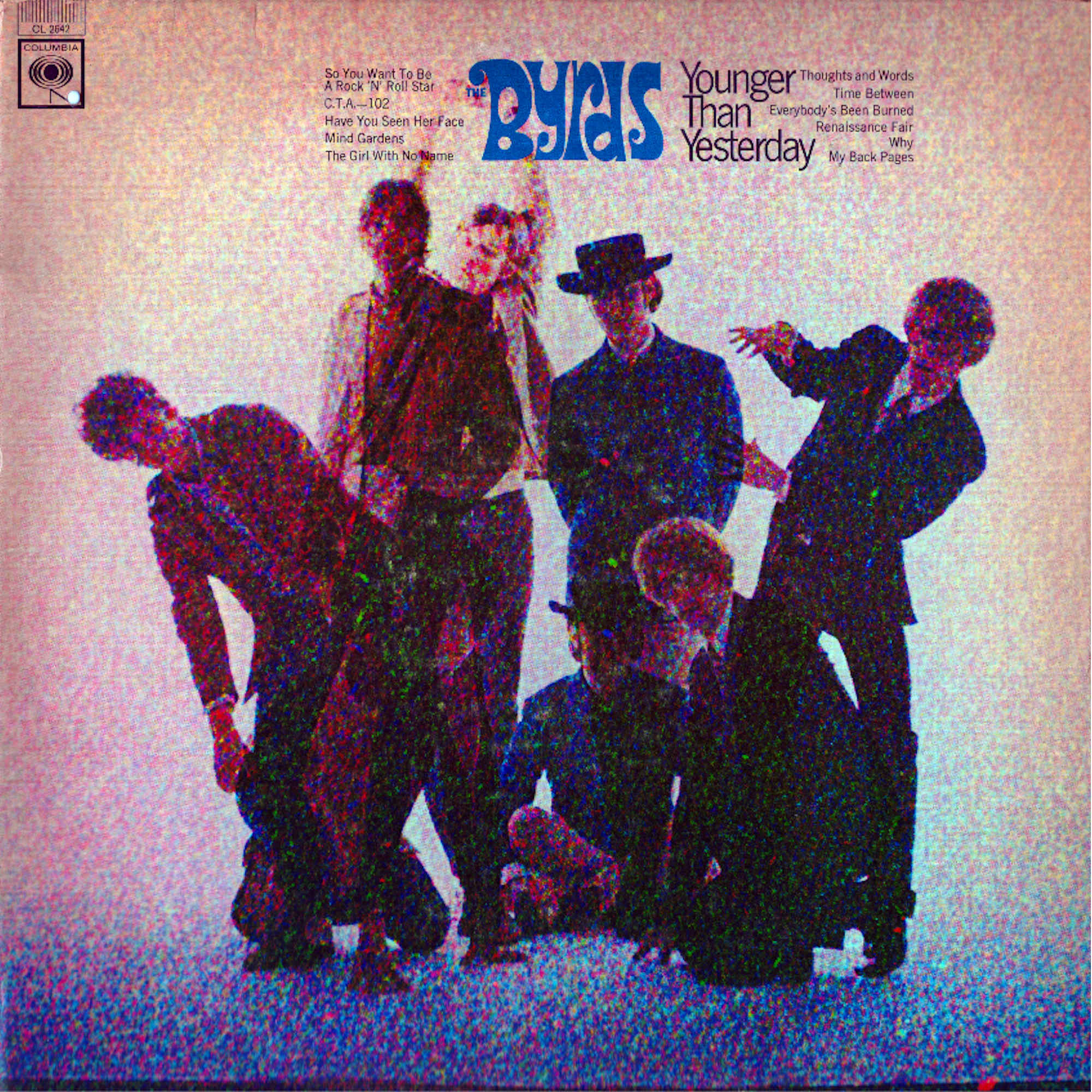
“Thoughts And Words” is my pick from the LP | The Byrds – ‘Younger Than Yesterday’ (Columbia CS-9442) February 1967
Article published in Crawdaddy!, August 1967
The Byrds: Eclecticism and Formalism in ‘Younger Than Yesterday’ | A girl, listening to the Byrds’ version of “Mr. Tambourine Man,” a girl who loved Bob Dylan, once said, “I don’t like it because it sounds like church music.” Meaning that she didn’t like it because she didn’t like church music.
Now I realize that she – being a Dylan fan in the spring of ’65 was probably a word freak who didn’t have a notion in the world about the Byrds and their formal problem. I, on the other hand, thought the Byrds just sort of sounded generally mysterious.
Anyway I really was surprised by them. And this was before I knew much about what the Byrds had to do with magic, science and religion. Or much about the Byrds’ peculiar favourite form. And long before the Byrds appeared to become really self-conscious about what they were doing.
Rhythmic patterns
The Byrds have real formal constancy. From time immemorial they have grounded their music in what are – or what seem to be – obviously regular rhythmic patterns. It is out of this ground that all developments and variations seem to rise – as it were to the surface.
This sound is dense, but not obviously and impressively complicated. That is, it is very coherent. It works because of its unity, not out of an accumulation of contrasting effects such as volume changes or syncopations. Here the contrasts inherent in any rhythmic pattern are not at all emphasized. The changes in the basic rhythmic patterns are not necessarily gradual but rather non-dramatic.
The Byrds: Eclecticism and Formalism in ‘Younger Than Yesterday’
The Byrds’ music is not at all progressive. In comparison to say the Jefferson Airplane, the Doors, or the Yardbirds it’s awfully calm. It doesn’t go anywhere. The resolutions are not dramatic. They don’t obviously end anything. Instead they are cyclical. But the cycles aren’t closed. It’s clear that they could quite probably go on for far too long.
It’s really nice that the Byrds should stop only when somebody decides to do it. Not when it’s necessary. The great Byrds challenge the tradition of the fade-out by making it into a mere decision rather than a matter of pleasure, logic or endurance.
Eclectic
The Byrds are eclectic. That’s what the guy on the back of their second album said. (“This album is eclectic.”) But the prominence of the form undermines our knowing anything about all that. When the Byrds got started somebody (in Hit Parader, I think) said that their first album was very nice, but it all sounded the same.
Now we are up to taking that. It’s become a virtue. What started out as a folk-rock style on the first album has been turned, via repetition, into a form. The formal structure of a constant rhythmic ground can overcome any material. The rhythmic ground is so dependable that once when lying on a cliff overlooking the Long Island Sound, not so far from where Walt Whitman did it, I thought I heard the earth turning beneath my head and it reminded me of – of all things – the Byrds.
That Is, the Byrds’ music has that sort of dependable self-energizing kineticism. It doesn’t go anywhere. But it never comes to rest. ‘Turn! Turn ! Turn!’ And that’s very strange and also very sad.
The Byrds: Eclecticism and Formalism in ‘Younger Than Yesterday’
The latest works of the Byrds are on this album, ironically titled ‘Younger Than Yesterday’, on which the Byrds give us magic, science, religion, psychedelic sounds, lots of electronic stuff and technological tongues, love songs, Dylan (who could have been influenced by Whitman), rock and roll, science fiction, some Southern California local lore, an African trumpet guy, a country and western guitar guy, a little bit of raga and so forth.
They refer to all sorts of people including their older selves and yet after a while it winds up sounding pretty close. Even the abundant amazing sounds are far too amazing to remain that way for long. They make themselves very familiar. That’s how strong the form is. Unique to rock, the Byrds are so formalistic that even when they do something now It’s hard to tell.
But the Byrds are conscious not only of their peculiar form but also of their own place in the rock firmament. Everybody knows that the Byrds are an odd case. After all, only the Byrds, amongst modern rock stars, have managed to change their status from stardom to cultural heroism.
I Think That Maybe I’m Dreaming
That is, as one 45 after another didn’t make it their quality still kept up. And this maintained the fierce loyalty of the small hardcore of several hundred thousand knowing fans. Not enough to make them traditional rock stars – a category wherein the charisma depends upon the quantity – but enough to keep their name in circulation.
And so when the Byrds recorded “So You Want To Be A Rock ‘n’ Roll Star” there was some real irony at work. They went to the trouble of building in the screaming – but who could possibly scream at the Byrds? That’s just not their thing. But recent live performances of this song have further complicated the irony.
The Byrds: Eclecticism and Formalism in ‘Younger Than Yesterday’
The Byrds have sounded so bad live that they might as well be in the Stones/Beatles/Herman category. In other words everybody knows that they could do it well live, if only because lots of folks have seen them do it well. But recently they haven’t bothered. The performance quality has become gratuitous. It’s as if you couldn’t hear them. Because of which it wasn’t worth trying on their part. Except that you can hear them – since nobody screams. And so when an audience refuses to cooperate by screaming they just ruin everything.
“CTA-102” moves the science fiction of the 5-D album out into the whole universe. It contains probably the first instance of star-noise in rock. Some people with a Platonic bent tend to regard this song as a fusion of inner and outer space. God only knows. But this is one of those songs wherein so many of the big Byrds themes are brought together: Magic, Science, Science Fiction, Flying Saucers, Technology.
So self-conscious were the Byrds that “CTA-102” makes the most bizarre use of the “Twinkle, Twinkle Little Star” tune since Mozart’s “Variations on Ah Vous Dirai-je Maman,” K. 265. The pure monotony of much of it is also noteworthy.
Distorted sounds
The Byrds are so self-conscious that they refute the supposed obligation to be interesting – or at least amusing, and surpass even their own “Lear Jet Song” by presenting many seconds of merely monotonous sounds: i.e. the star noise and the space freak’s speech.
And all this coated with technological sounds, electronically modified, produced, distorted or filtered sounds, Bizarro or real star noises, not-so-obviously melodic guitar playing – all culminating in those merely monotonous sounds which constitute a technological anti-tongue.
In terms of an essentially formal self-consciousness the album’s high point is the really tired “My Back Pages.” First of all “My Back Pages” immediately follows the much too freaky and overly mysterious “Mind Garden.” As “Mind Garden” ends with a spectacular technological tongue which is disqualified just because it is one among too many, on comes “My Back Pages” sounding as if we had always known it.
The Byrds: Eclecticism and Formalism in ‘Younger Than Yesterday’
The contrast is magnificent. “Mind Garden” is the pigeon for “My Back Pages.” Significantly this song is one of the Byrds’ lately numerous hits-that-failed. It seems to have what De Chirico called “The Lassitude of the Infinite” about it. Some girl once said that only the guitar break betrays it as brand new. But it still sounds – with its excessively deliberate pacing – infinitely weary. They are only grinding it out.
But make no mistake, this is the most purely formal thing on the album. It is all form, structure, habit. Very archetypical. Imagine the Byrds at this stage of the game, on their fourth album, called Younger Than Yesterday, doing Dylan. And Dylan off of Another Side of Bob Dylan at that. It’s like deja vu. The song is so immediately over-familiar that that constant rhythmic form is very visible. Here over-familiarity insures the music and the words failing to get in the way of the form. Why you can almost hear the Earth turning.
The rest of the album continues the mastery of form over an eclectic variety of styles. It is as if the Byrds had developed a modular concept, whereby things could be “formalized” or plugged into the form.
Thoughts And Words
Now the country and western like “Time Between,” “Girl Who Had No Name,” and “Have You Seen Her Face,” as well as the awfully mysterious “Renaissance Fair” and “Everybody’s Been Burned,” can all be subjected.
“Thoughts and Words,” which is equally mysterious, uses its seeming over-similarity to middle period Beatlism to lull us into a sense of comfortable familiarity – which only serves to make it more mysterious. Because of the tension between its seeming familiarity and its form.
And last, but not least, there is “Why,” the point at which the Byrds refused to maintain their tradition of ending at least one side with an obvious joke, such as “Oh Susannah,” “We’ll Meet Again” and “The Lear Jet Song.”
“Why” also represents the pulling in of the raga horns from the flashy/spectacular of the earlier flip-side version to the merely pleasant plausibility of the present one. At last the form has tri-umphed over both the urge to laugh and the urge to display. (Sandy Pearlman)


Leave a Reply