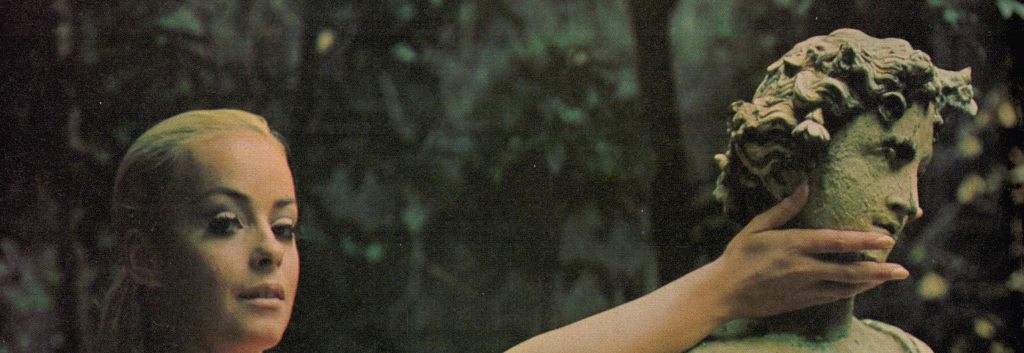

ERIC BURDON • The Best of Eric Burdon and the Animals. Vol. II (MGM E-4454)
Tracks: When I Was Young; A Girl Named Sandoz; Don’t Bring Me Down; She’ll Return It; See See Rider; The Other Side of This Life; Hey Gyp; Help Me Girl; That Ain’t Where It’s At; You’re On My Mind; Inside Looking Out; Cheating. Burdon, vocals; remaining personnel unlisted.
During one of the several times we listened to this recording, my friend and unsigned co-reviewer Tom McCormick remarked that it was a constant struggle not to get up an put on something by the Rolling Stones. Though perhaps overly harsh, that about sums up my feeling about Eric Burdon and the Animals (the older group, to be distinguished from Burdon’s present sidemen, the New Animals, whom I haven’t yet heard).
Eric Burdon | “Best Of” | (MGM) 1967
Some explanation of that statement is needed. If rock music had stayed put at its mid-1960s level, there might be no reason to fault the Animals. But that’s just the point: the best British rock groups—most notably the Beatles and the Rolling Stones — have never been content merely to continue doing the same thing.
Admittedly, all of the Britishers began with straight-out neo-minstrelry, imitating American Negro artists like Howlin’ Wolf, Muddy Waters, Chuck Berry, Bo Diddley. What distinguishes the first rank bands from the rest is their markedly greater inventiveness, their adamant refusal to allow the music to become static and rigidified at any one point, (just compare the Beatles’ Sgt Pepper’s Lonely Hearts’ Club Band with any of their early LPs) .
This is the context in which groups like the Animals have to be evaluated. Leader Eric Burdon has frequently been quoted as saying that his preference would be to have the Animals stay in what he calls a hard blues bag, meaning scarcely disguised English versions of Negro blues (‘Cheating’ is one example of the genre on this album).
Fortunately for him, there is a declining market nowadays for that sort of thing. I say fortunately because quite honestly I cannot think of a bigger drag than to have a gaggle of white youths spend their artistic lives rehashing a form that has already been brought to perfection by its black originators.
The blues have come out of a specific environment, they make greatest sense only in terms of that environment, so why waste time trying to produce note-for-note copies of something that has been done as well as ever it can be and that is based on an experience you will never have?
Eric Burdon | “Best Of” | (MGM) 1967
Imitations are invariably less interesting than the originals, a verdict which holds not only for the Animals in their blues groove, but also for the Butterfield Blues Band, the Blues Project, and the rest of the groups of that ilk.
Since the demands of the market did not permit the Animals to remain a strictly blues group, Burdon apparently tried to meet this challenge by taking the band in the direction of the Rolling Stones, who were also rooted in the blues during their early days.
Sometimes this has worked out fairly decently: ‘When I Was Young’ and ‘Don’t Bring Me Down’ manage to get something of the electricity that a good Stones performance will generate. But on the whole, trying to outdo the Stones at their thing is as fruitless as trying to out-blues the ghetto artists at theirs.
The reason for this of course lies in the genius of the Stones’ Mick Jagger, who is not only as exciting a singer as I have ever heard—his is the only voice that produces the same hysteria in me as John Coltrane’s sound—but an inspired lyricist in the bargain (whereas Burdon has publicly acknowledged that the Animals have a great deal of difficulty in writing their own material, as is much in evidence on this album).
Eric Burdon | “Best Of” | (MGM) 1967
There are times when the Stones simply will not let you remain sitting; their music (as in ‘Satisfaction’) demands your physical participation, dragging you, however reluctantly, from your chair. If the Animals had that charisma, you could forgive the triteness of some of their lyrics. But Burdon lacks the Jagger edge in his voice: none of his male followers will ever be driven so far out of his head as to pick up a chair and heave it at his idol, something that reportedly happened at a recent performance by Jagger and the Stones.
And that is why, after hearing this record, you want to follow it with the Stones—turned up as loud as the neighbours’ sensibilities will permit—to drive the dross from your brain. If you compare this collection with High Tide and Green Grass (check out that title!—it means what it says), the anthology of the Stones “biggest hits,” you will see that though the Animals are pleasant enough in their way, there is really no comparison at all.
In the last few months, besides forming his New Animals, Burdon has spoken at length of his respect for Frank Zappa of the Mothers of Invention. Perhaps the iconoclasm of the Mothers will encourage Burdon to seek a direction of his own, for that is the only way his music will ever leave a permanent mark. — (Frank Kofsky – Jazz & Pop, August 1967)


Leave a Reply