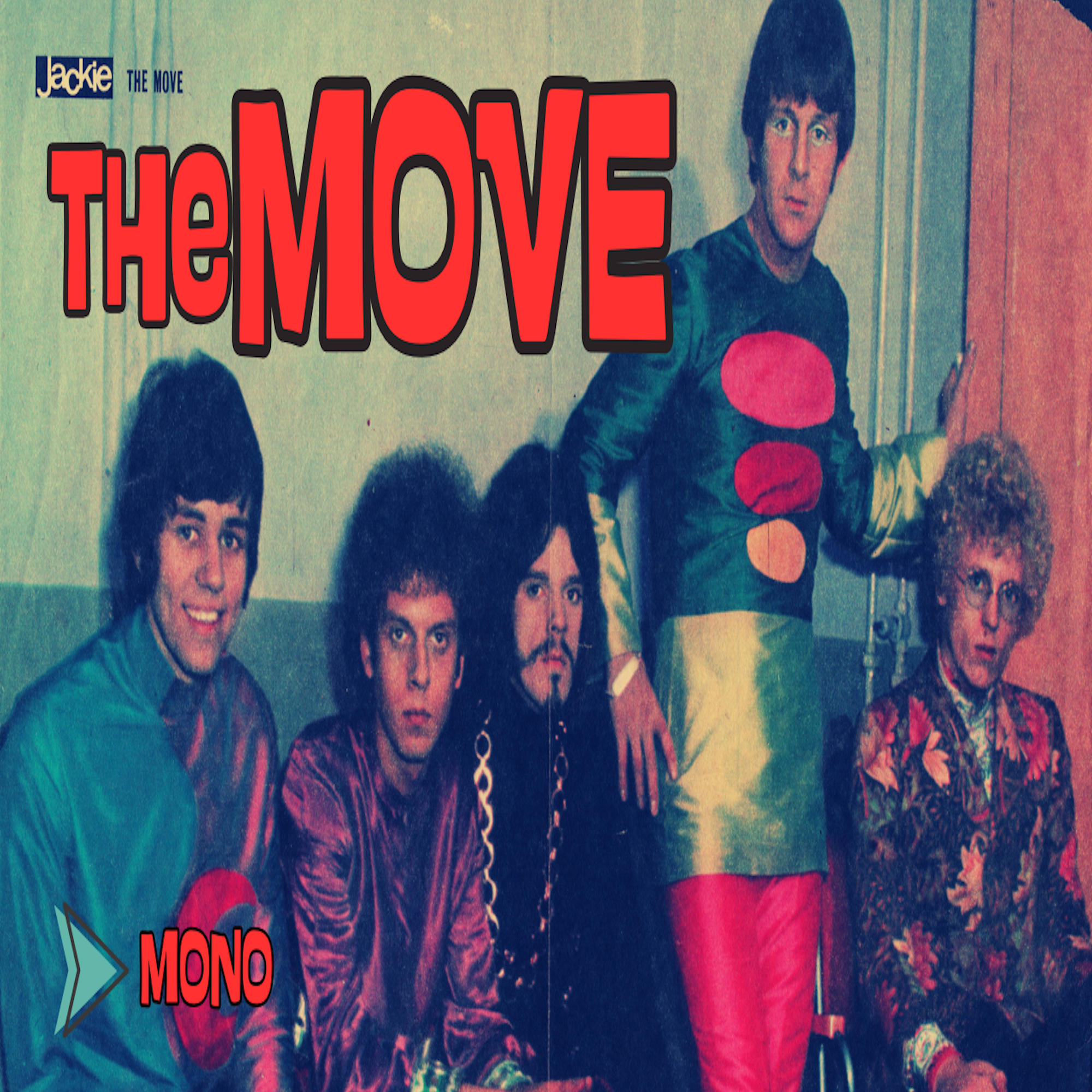
THE MOVE – ’Flowers In The Rain’ / ’(Here We Go Round) The Lemon Tree’ (Regal Zonophone RZ 3001) August 1967
The Move | Flowers In The Rain | Regal Zonophone | 1967 | Just can’t figure out why so many people rave about the Move – their records don’t seem all that good to me. They have even offered to play to U.S. troops in Vietnam for free – unbelievable.
Their “Flowers In The Rain” isn’t a terrible record but, on the other hand, it’s no mind-boggler either. The rhythm is solid and loud, so no doubt some boppers will do their small nuts to it at the local Palais de Danse. Good luck to them!
Predictably, the words tell us how great it is to sit in the rain watching the garden grow, which is fair enough by me but a bit hackneyed. Still I’m told that potato power is the in thing to turn on to now, so maybe that’s what we’ll be hearing next from the Move. (Intro, 30/09/67)
THE MOULDING OF THE MOVE
WITH the exception of The Beatles and The Rolling Stones, few artistes hit the headlines in the National press as consistently as The Move. Their news-value, their success, their string of hits, their increasing popularity can be traced to one person — manager Tony Secunda. An interesting person whose own career is as fascinating as any pop group’s outline, Tony first became interested in show business when he opened a club in Leytonstone with Chris Andrews.
Discussing his past achievements, he says: “After we’d opened the club in Leytonstone with a big publicity campaign we found that the place was becoming packed every time we opened the doors — and by the time I was 18 I was earning £150 a week. I met Stanley Dale, who managed Tony Hancock, Spike Milligan and Eric Sykes and we shared an office. Then we went into partnership and opened a string of ballrooms.
I ran into a guy one day called Johnny Kidd. He’d had a minor hit record but as all the National papers were on strike he received no exposure at all and was complaining about having no work. Clem Cattini, Brian Gregg and Alan Caddy were his backing group and they were only getting about 30s. a night, five nights a week. I took over, upped their money — and they started happening. At the time I was also running about eight venues. ‘Shaking All Over’ hit the charts and we became the first people to quote £100 and £150 for one night. People said ‘you’ll never get that sort of money for a No. 1 record.’
Showmanship
“Not long after that I quit and went into Wrestling with Paul Lincoln — and that’s where I first began to know what it was all about. I had to zoom around five nights a week. I’d go to a drill hall, set up a 1,000 chairs, number them, set the lights up — run the whole show myself, in fact. After the show was over I’d pack it all up, go out and put about 150 posters around, leap into the next town and do it all again. I did that for about a year. Paul Lincoln was the guy who really turned me on — that’s where I learned about showmanship.
“I made so much money out of that that I went crazy for a while. A guy called Alex Murray said ‘Let’s go to South Africa’ and I looned off there with him within 48 hours of him making the suggestion. Over there we sang and produced records with Mickie Most — and Mickie had about ten No. 1’s there. Then I went up to the Congo for a month and then returned to Britain and found The Moody Blues.
“At that time I knew how a group should be presented and how to promote a group — but there were a lot of things I didn’t know. Within six months of my having found them they were No. 1 — which was too much, too soon. It all happened too quick for me and for them. About six months after ‘Go Now’ I quit completely and went to Tangier and dug the A-Rabs. I drew from all my experiences and decided that in future I would never have another partner. I got married in the meantime.

Birmingham
“I came back to England in January ’66 and immediately started looking for a group and spent three months searching the country, saw something like 150 groups, probably more. I knew what I was looking for but couldn’t find it. Then one day in March I went up to Birmingham and there they were. I knew immediately I saw The Move that this was what I’d been looking for. The guys themselves knew what was happening, knew what they wanted. Fortunately, they’d refused to sign an agreement with anyone up there.
“I started re-organising their act on the spot.
“They’d been playing Beach Boys numbers and Top 20 material to make a living, because people insisted. But I made them cut all the Beach Boys gear out, told them to forget the Top 20 and start writing their own stuff. The great thing about it was that they did exactly what I told them, took my word as law. The change was unbelievable. I decided not to introduce them to London, but to develop them in Birmingham — and the next thing was to get their minds working progressively. They all so much wanted to make it that they really tried — they were so determined that you can see it in their performance even now.
I used to bring them down to London one day a week — I knew it would be very unfair to put a record out and launch them on the London scene. The first time they played the Marquee, as a support group to Gary Farr, they had the horrors before they went on. I was determined not to hurry them — and the second time at the Marquee they were far more relaxed.
Denny Cordell
“We all realised that after the Mersey boom the scene had become uninteresting — and we wanted a very visual thing. I was determined to get a front line of four 1968 Mick Jaggers and made them aware of the importance of presentation. The people in London began to come and see them and we let it progress naturally. They did a few crazy things that caught people’s imaginations — like borrowing a replica of an H. Bomb. They slowly developed until at one stage last year they had something like twenty offers for recording contracts.
“I checked out all the A & R men on the scene and decided that the only guy in this country with a good mind and a progressive mind was Denny Cordell — and we set up a deal.
“Prior to this there had been so much interest in the group that they were earning as much as some hit recording groups and they hadn’t even made a record! They were a little bit ahead of what was going on — and they looked good. By the time the record was due to come out all the radio and TV people had read about them — and it wasn’t as hard as trying to sell an unknown quantity.
It wasn’t necessary to have to beg people to put them on a TV show or a radio show — the people felt The Move were something they had to use because they were new and exciting.
“To sum the whole thing up, it’s really a case of building the mountain for Mahomet to come to — the sky is the limit . . . the sky’s the limit for anybody in this business.” (Record Mirror, 16/09/67)

Move-Moving on from the crossroads
FOR a group with three hit records under its belt—“Flow-ers In The Rain,” which was last week’s biggest chart leaper, looks like being the biggest yet—Ace, Carl, Trev, Roy and Bev, otherwise known as the Move, are curiously unsure of their development in the near future.
Unlike most groups with three hit records to their credit the Move have never been on a major ballroom tour; have not had an LP released; have not visited the States.
In fact, three records after they made a big name for themselves playing in clubs round the country, the Move find themselves at something of a crossroads.
“We are really in a very good position right now,” said lead singer Carl Wayne this week. “There are so many things we want to do and so many different ways we can expand from here.
“We’re going to the States early next year and in November we do our first ballroom tour—with Jimi Hendrix.
Rebuild it
“So we’re going to change all our material—work out a completely new stage act. We’re going to change the lighting system we use onstage—destroy the whole thing and completely rebuild it.
“And we want to destroy the idea of a group playing at one end of a ballroom with just a loudspeaker system and lights and the audience in the middle—it all seems very out-dated.
“Of course pop’s reached a stage now where everybody’s tried to progress as much as they can. We ourselves haven’t progressed as much as we’d like—we just haven’t had time to work things out yet.”
Group’s songwriter Roy Wood, who penned all three of their hits and looks something like an evil Russian monk with newly-grown beard and moustache, agreed. “So we are going to take a couple of weeks off before we go on the tour and spend the solid two weeks just working out new stage material—a whole new act, in fact.
“We want to re-inject some of the old enthusiasm we had back in the days when we used to play the London Marquee.”
Drummer Bev Bevan added: “And the LP should be out by Christmas, according to our producer Denny Cordell. We have cut a lot of tracks for it but we weren’t too happy with all of them.”
Nest single
But while bursting with creativity and plans for a progressive future the Move are a little worried over the fate of their NEXT single—the one AFTER “Flowers In The Rain.”
“For some reason the fourth record seems to he the most difficult—it should be strong enough to carry the next two or three into the chart, just as your first record should arouse enough interest to give the next two a good start,” said Carl.
“It’s funny—a lot of groups have hits with their first three records and then miss completely with the fourth.”
What should the next single be? It’ll probably be nothing to do with either grass or flowers—in fact a possible number, which is already recorded and “in the can,” is about a lunatic asylum!
“It’s called ‘Cherry Blossom Clinic’,” said Bev. “It’s a very good song, and I think we enjoyed doing it more than any of our other singles.
“If we don’t put it out as a single it’ll make a very good LP track.” (Disc & Music Echo, 30/09/67)
We’re Just Five Ordinary Guys say MOVE
THE most talked about, most written about, most outrageous—yet one of the most quiet-spoken groups on the scene. That’s the Move, whose record “Flowers In The Rain” climbs to No. 8 in this week’s chart. In conversation, its members hardly say a word. Yet next to the Beatles and the Rolling Stones, the Move has undoubtedly had more Press coverage than any other group in the past year.
Firstly its ‘thirties-styled outfits caught the imagination of the fashion writers. Then it smashed up a car on stage and had the audience joining in. Then it used two strippers in the act. And now, almost as if to round things off, these consistent hit-makers find themselves involved in a legal dispute with the Prime Minister.
Strangely, at the beginning of 1967 few people outside the Birmingham area had heard of the shy, silent Move. That was until its first single “Night Of Fear” was released.
Changed
To discover how members Carl Wayne, Trevor Burton, Chris Kefford, Bev Bevan and Roy Wood had developed after six months and three hit records, I drove with their manager, Tony Secunda, to see the group in action at Stevenage Locarno.
“The Move change their ideas every week,” Tony informed me.” The clothes they wear, the music they like, they all change with their moods.”
Tony Secunda is the dynamic young man who searched the country trying to find the right group.
“I watched at least 200 groups before I saw the Move, and I knew straight away that they were just what I was looking for. They were the only group out of hundreds that generated excitement—they were trying to do something more than just play other people’s hits.”
When Tony saw them in Birmingham they were at that time playing Top Twenty numbers, but he persuaded them to write and play their own compositions.
Five friends
“The Move were a complete unit. They were five friends from Birmingham and they stood by each other throughout everything. They all thought along similar lines, they all liked the same things and they were unsure of anyone who tried to break in on their scene.”
We eventually arrived at the ballroom where the group was just preparing to go on stage. Carl Wayne was preening himself in front of a mirror while the others sat around tuning their guitars and watching a TV set.
All of the group are delighted with the success of “Flowers In The Rain” because it’s “a bit different from our previous record,” said Carl.
They are all keen to progress musically. “We want to move forward all the time,” added Trey Burton, “but at the same time to please the public. We try to do something different on all our records and we try to project something different every time we appear on TV.”
Manager Secunda nodded in agreement. “The Move have no other image other than that of five ordinary blokes. We have never tried to turn the group into anything they are not.”
Tony and I left the dressing-room and walked upstairs to watch the act from the balcony. The lights on stage dimmed. The crowd screamed and a few minutes later the Move burst into action.
Excitement
The pounding drums of Bev Bevan, the blend of three guitars, the movements of Carl and the flashing lights all combined to produce mass excitement. Then they were gone, leaving the crowd to dance or go back to their drinks. They would dry off a bit, change their clothes and head back to London.
As Tony and I drove back to town, I asked him what it was that caused such excitement. “I think basically it’s because of their association with the kids.
“The girls like them because they could be brothers or boyfriends, and the boys like them because they can see themselves up there with them playing guitar or drums. As I say, they’re just five normal lads!” (NME, 23/09/67)


Leave a Reply