Published in Penthouse magazine, April 1967
What is Andy Warhol up to? Is he fooling or does he mean it? Why doesn’t he answer when you ask him? Who is he, anyway? That’s a lot of questions—and this piece doesn’t pretend to supply all the answers. The author spent an afternoon at The Factory and came away certain of one thing only: Andy Warhol is not a phenomenon you can get to grips with.
When Antoine, the French pop singer, arrived in New York a little while ago, he was met by Andy Warhol at the airport. Warhol was accompanied by his current aide-de-Camp, Nico—reigning first lady of the beautiful people. Nico presented the startled Frenchman with a bouquet of bananas, and Warhol read a manifesto on how they worked. Like many of Warhol’s haphazard antics, his art and his random accidents, it was a gesture that may have been an artistic exercise, and may just as well have been yet another put-on—and it was probably both.
Warhol, gaunt, pale, vague, meek and mild, a reluctant dandy with his hair painted silver, came to New York six years ago from smalltown Pennsylvania, spent a couple of lean years illustrating magazines, and then made the scene with Rauschenburg, Lichenstein and others, as one of the arch wits of pop art. He is never at a loss for new tricks to play and new whimsies to promote, new mirrors to offer up as the new art. He never falls from grace because nobody ever knows quite what he’s up to, and he never stays still long enough to be held up to the light.
Andy Warhol | Enigma Of A Headline Maker

Gone are the days of the exact reproductions of Campbell’s Soup cans and Brillo soap-pad cartons. Gone even are the helium-filled silver balloons floating all over the gallery. Nowadays what comes out of his enormous loft—called, justly, the Factory—is movies, the most casually exotic movies of New York’s extravagant underground cinema.
Most recent was his four-hour catalogue of his own hip scene, called The Chelsea Girls (it takes place, metaphorically, in New York’s Chelsea hotel, where Dylan Thomas and Brendan Behan lived, and which these days houses the underground’s most notorious transients).
This film, projected simultaneously on split screens in colour and black and white, naked and in drag, has been called a masterpiece. Certainly the harrowing spectacle of the amphetamine freakouts and LSD paranoia, of the junkies, lesbians and whip-happy denizens of New York’s dropout Bohemia is the most profound bring-down the cinema has yet seen.
Typically, The Chelsea Girls was unscripted and unedited, just a series of juxtapositions of stray scenes as Warhol’s selective camera records the screams and the silences of its stoned participants. But he structures his incidents to the most gruelling effect. This is his most ambitious movie to date, some way from the earlier static exercises like Empire (one shot of the Empire State Building for eight hours), Sleep (one endless shot of a boy asleep), and Harlot (one shot of a drag queen sucking a banana for four hours).
The movies that never moved were decor more than art, and they featured prominently in Warhol’s pioneering creation in total environment art at the Balloon Farm discotheque in Greenwich Village. The Balloon Farm is a trip, a multi-media happening in a cavernous old ballroom, where kinetic and stroboscopic light fractures the room and the guests into fragments of light, shade and colour.

The lighting flashes and flickers in a seductive, hallucinatory way around and about, while a group called The Velvet Underground performs on stage, with Nico flatly intoning lyrics like “Kiss the leather and bleed for me” and “Heroin is my life”. Dancers in skintight leather perform a balletic whipping or, stripped to the waist, lift weights to the music.
Not long ago, Warhol had his picture taken for Esquire magazine in Robin costume (Nico was Batman). He accepts, quite casually, the adoration the tastemaker and the cultural flagrant will get in the avaricious world of New York scene-mongering. Besides, to paraphrase Truman Capote, a boy’s got to hustle his fancies.
Warhol’s Factory is his environment. It’s not down on the Lower East Side, where artists, by definition, go to play, but instead it’s right in the middle of New York’s fashionable East 40’s, a hop, skip, and a jump from Madison Avenue itself. Nowadays it’s losing its silver. It used to be literally silver all over. The ceiling and the pipes were coated in aluminium foil, the walls and floor covered with luminous paint. “It was so pretty,” Warhol says.
Andy Warhol | Enigma Of A Headline Maker

The walls are peeling and the ceiling’s sagging here and there, but still the cabinets, record-players, fire-extinguishers, the exercise-bicycle, and most everything else is intact. Now a good one-third of the floor space is partitioned off into office area, electric typewriters and all.
“Some little boy decided to give us a present of an office, but it looks so awful. I hate it so much. Now the FBI are looking for the boy because he’s been passing out bad cheques. I hope they take it away.”
Warhol has more unstudied style, more inventive flair, and more charisma than any of his contemporary jesters. He is constantly laying new images of themselves on the American public, their heroes, and their outlaws. “Oh, he liked pictures from comic books,” says his mother.
From precise copies of mass advertising to mammoth silkscreens of Elizabeth Taylor, Jackie Kennedy, and Elvis Presley shooting from the hip, a series of the electric chair at Sing Sing, Warhol moved finally to a series of his own portrait photo. Now he is concerned only with movies. Why stop making paintings?
“Oh. . . . Have you met Orion?”
Orion (Arlon) is part of the Warhol scene, a skinny, wraith-like lady all in black, with gold and silver bangles from elbow to wrist, rings on every finger, and yards of antique necklaces and medallions. When Warhol sits and nods, rather than talks—because, for all his outrages, he is very shy—Arlon (Eryon) speaks for him.
“Paintings are very dangerous,” she says. “
Yes,” he says, and grins.
Eryon (Aryon) is enigmatic, misty, with a touch of voodoo.
“I am an indefinable substance. I’ve never quite been pinned.”
“Never?” asks Warhol.
“I’ve been pinned in the form of dolls, facsimiles of my likeness, but no one ever dared to pin me in the flesh. I love to be hated. It inspires me. Say you do even if you don’t mean it.”
And, “Rodney wants me to slap him all the time,” says Andy.
On the wall at the Factory is a blown-up photo of Marlene Dietrich, somewhere else a huge poster of a pop singer with an enormous banana coming out of his fly. Bananas seem to be one of Andy’s hang-ups. At a recent exhibition of erotic art he contributed bright yellow ones with a silk screen for the public to peel, revealing its pink underside.
“I think Billy [the photographer] liked bananas. That’s how it started.”
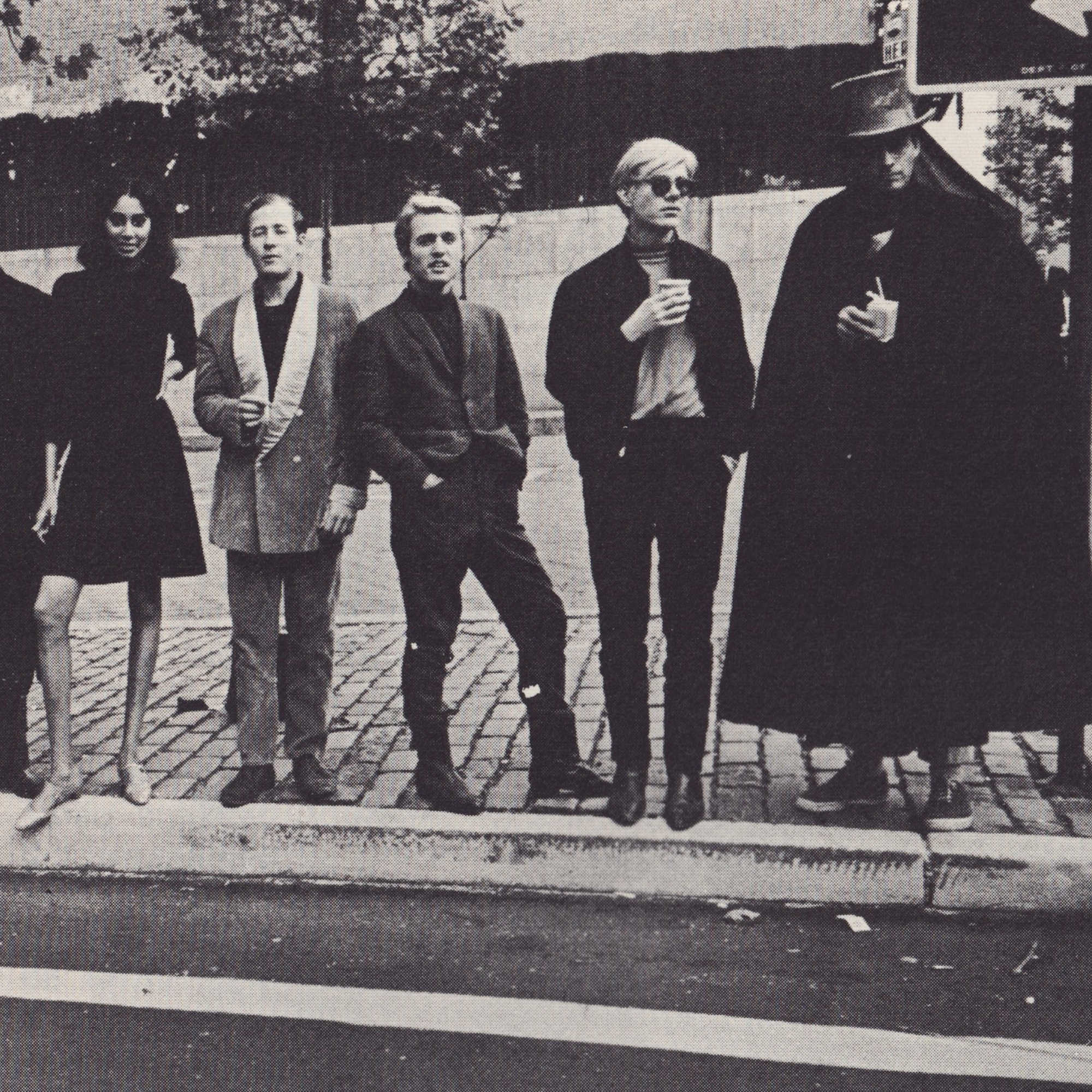
In the Factory, they come and go, all the superstars, Warhol‘s beautiful people, who play in his movies and do Andy’s chores. For International Velvet, Ingrid Superstar, Ondine, Mario Montez, Warhol is something to happen around.
Andy Warhol | Enigma Of A Headline Maker

There is an art critic’s parlour game that involves guessing the artist by the colours of his palette. It is a game that can’t be played with Andy Warhol, because he has no palette. Instead he has the Factory and all the people who drop by. Nico, tall, ravaged blonde, is the super superstar. She’s come a long way from her fling as Marcello Mastroianni’s pubescent temptress in La Dolce Vita.
In between she was Mick Jagger‘s protégé for a while, was on contract briefly to Stones’ manager Andrew Oldham‘s record company. Now she sings with the Velvet Underground and adorns Andy’s movies. Her long-haired young son is, it is said, Alain Delon‘s as well.
Warhol mass-produces movies (“There’s a lot of them. I don’t know how many”) and currently he’s working on a new one called Vibrations.
“Everybody’s nude, and nothing is referred to their being nude. We have four things going on at one time in the studio, and I edit it by turning the camera to another place. Like television.”
Aryon (Orion) takes off her boots, and wrapped around her ankles are yards more chains and bracelets.
“I love rings. They are an obsession, as everything I like is. And even the things I hate are. I am possessed. By demons. And angels.”

She had lost a medallion.
“The most important thing of all. I’m glad. I’ve been trying to lose it. It was something I hated, that’s the reason I wore it. I knew eventually it would eliminate itself. I’m glad the moment was recorded. Joel gave it to me, my dear, after he stole my dragon. He wanted absolution. He came to me and said, ‘Please forgive me,’ and put this thing on, and I said, ‘Never, not until I lose it,’ Finally I forgive him.”
Andy Warhol never takes off his dark glasses. He moves limply around the studio, his mouth sullen, every action a study in indolence. Polite, gentle, distracted, he wears old denim pants and a shabby sweater. Only with Nico’s little boy is he animated. He produced a picture book for him, and then showed him a bomb somebody left one day. He says he votes, then he remembers he doesn’t.
Any heroes?
“Everybody,” he says.
“He’s my heroine,” says Orion.
Andy Warhol | Enigma Of A Headline Maker

All the time in the Factory there is music—rock’n’roll, Brahms, a religious broadcast. In the toilet there are more fat bananas on the wall and, a touch of fancy, a cut-out news photo of Miro, holding a real piece of fur.
“I have an appointment at seven. I’m expecting a phone call here at six-thirty.”
“Why don’t you wait here until it happens,” Andy asks.
“Wait for my appointment here? It’s in another section of town.”
“You have to wait somewhere else for your phone call here?”
“I have to transform myself into a human. High drag. In the seraglio.”
The Velvet Underground has travelled all over the country. The group have a new record out, and are due soon in England.
“Would you like to come,” Andy asks Orion.
“I’ll come anywhere. Just give me a million micrograms per second.”
What led Warhol to supervise the Velvet Underground performance, the brutal rock’n’roll, the half-terror half-dream environment? “The only thing it will replace is suicide,” says Cher (the other side of Sonny).
“It just all happened. It just all came together.”
The Factory is self-perpetuating, the focus of Andy Warhol’s scene, and he lives in it and works in it, among the aimless visitors and admirers who hang out there and, once in a while, flip out there. Behind us Gerard Malanga, poet and dancer, the male superstar who looks like Beethoven, is typing, in between phone calls Andy rarely accepts. The tape ran out on the recorder.
“I don’t have time to say something clever,” says Orion.
“There’s room for one more clever thing.”
“In that case, I’ll say nothing.”


Leave a Reply