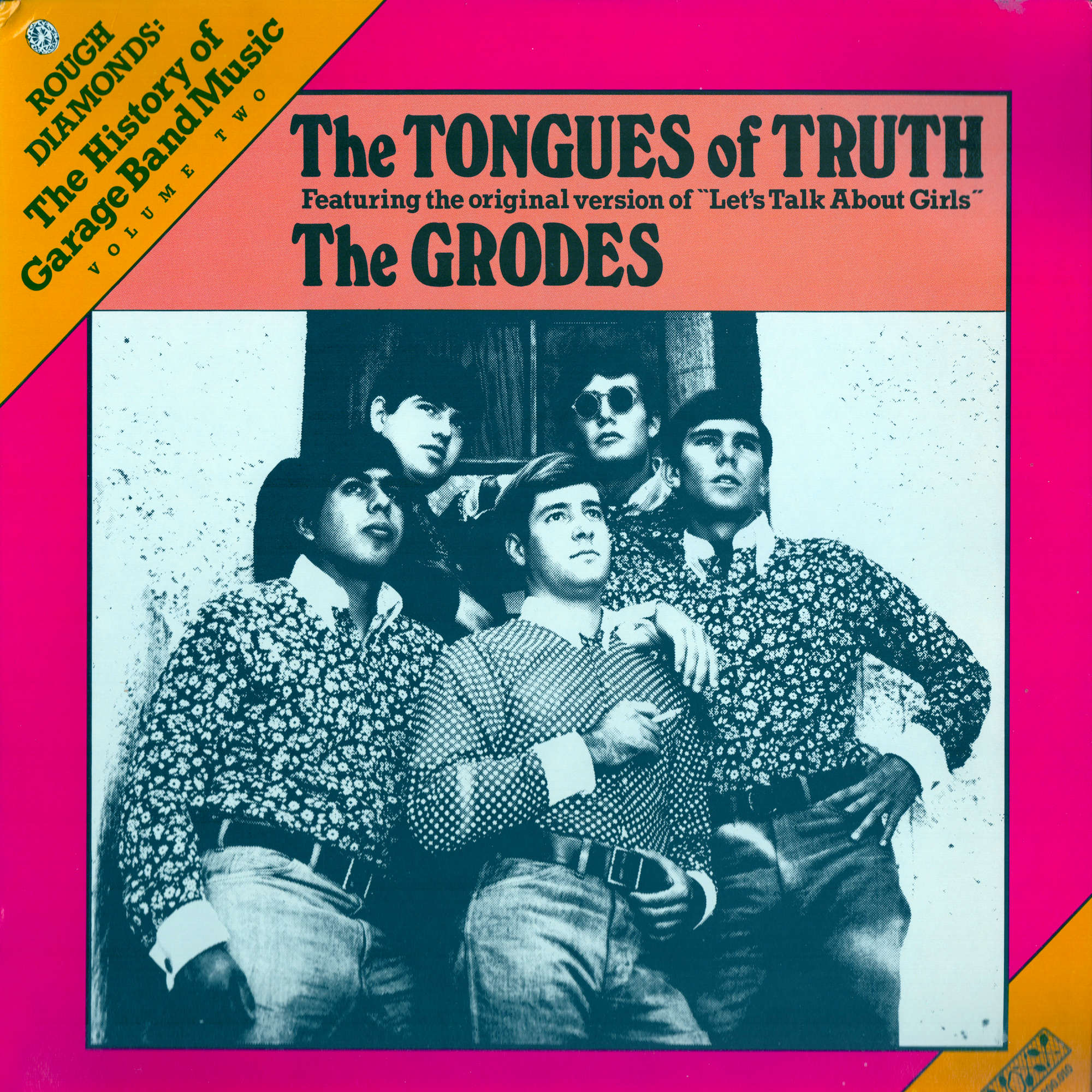
ROUGH DIAMONDS: The Tongues Of Truth | The Grodes
The mid-sixties; the first punk era; the Golden Age of Garage Bands. Whatever you call it, the years 1964-69 were a very special time. Thanks to a confluence of favourable conditions in radio, distribution, media, and musical culture, plus the surge of ‘baby-boom’ youth onto the scene, a worldwide youth explosion produced a wealth of innovations in music, the arts, style, and society at large.
The strength of this scene was its grassroots nature. Every town in America (not to mention the rest of the world) had its own, healthy music scene. In the U.S. there were about 20 distinct regional scenes, each with its own unique influences, and each with thousands of recording bands.
These records have become highly prized by collectors in recent years, and as knowledge of these local scenes grows, many young bands of today have begun emulating the style and sound of the ’60s, The parallels between ’60s and ‘8Os are myriad–rock & roll, reborn each generation, must inevitably return to its roots again and again.
Music Scene
The more we know about the past, the more we benefit from what has gone before. In this series of albums, we are presenting the music of the ’60s in its true, local context, and providing the background in which it can best be appreciated.
Tucson, Arizona had a music scene like every other city of the time, but unlike the more familiar scenes such as Detroit, Los Angeles, Chicago, etc., produced no national hits and did not have a strong regional scene to build upon. There was no ‘Southwest Scene” to speak of, although Phoenix, Albuquerque, El Paso, and to a minor extent Las Vegas all had active scenes, But due to the large distances between these cities, there was relatively little interaction.
Phoenix had the biggest scene of the region, a busy recording studio (Audio Recorders) to which groups came from all over, and a lot of hot bands, some of which (Superfine Dandelion, Velairs) got picked up by national labels. Others realized their best chance of making it lay in getting out of their backwater region; Alice Cooper and the Tubes left behind the local following to hit the big time in L.A. The other top Phoenix band, Phil & the Frantics (to be heard on a forthcoming album in this series) tried without success to make the transition.
Compared with Phoenix, Tucson was a small scene indeed. Although there were some fine groups (Breakers, Five of Us, Intruders) only two were consistent local hitmakers, the Dearly Beloved, and the Grodes.
Manny Freiser
Manny Freiser was lead singer and songwriter for the Grodes, a group well-known to collectors but usually considered an L.A. group since their records often appeared on L.A. labels. Further confusing the story, they had one record out as the Tongues of Truth, a group widely believed to be connected with the Chocolate Watchband.
We were fortunate to make contact with Manny Freiser and to get the whole story of the group, the Tucson scene, and the flavour of the era, direct from his pen. We. hope you’ll enjoy reading his comments, and listening to this album which, we believe, establishes the Grodes/Tongues of Truth as one of the most creative groups of the ’60s.
The development from early merseybeat to the delightful baroque Pop of their later records parallels that of America’s whole music scene from 1964-67, and at each stage Manny Freiser’s songs were solid, fresh and compelling. Had the group been based anywhere other than Tucson, no doubt their success would have been greater. Now in the words of Manny Freiser, here’s how it all transpired!
In the blast-furnace summers of Tucson, Arizona, several bands competed for the prime club gigs. The action focused on Speedway Blvd., at such clubs as the Doll House (this club always had the hottest bands; we took the Dave Clark 5 there for entertainment when they care to town), the Dunes (we were evacuated one night in the middle of “Gloria” due to a numb threat), the Cedars (a sleazy motorcycle gong handout where we befriended one gang to protect us from the others, and some old drunken loon came in every night and stood in front of the bandstand, all night, directing the hand, Smiley’s Embers (a strip club where we took our breaks with the strippers in their dressing room) and the VIP Club at Monterey Lanes (where we appeared, on the bill with acts ranging from Gary Lewis & the Playboys to the Nazz/Spiders from Phoenix, later to became Alice Cooper).
In the fall, winter, and spring, the active college scene at the University of Arizona kept all of us busy doing weekend one-nighters for the fraternities and sororities. The Parties were wild: often several inches of booze covering the floor; people kicking the mike into my teeth as they all “hit it” for the gator during “Gloria”, “Louie Louie”, “Money”, etc., gays punching each other out and dragging their dates across the lawn by the hair.
The highlight events were the Spring Formals. Usually held at some isolated ranch out in the desert, the kids dressed mostly in loincloths, beer trucks stood by, being emptied and sending in replacements. Students dressed in doctors’ coats syringed booze down to waiting cups from garbage pails full of strange and powerful concoctions up on the roof—and everybody rocked and rolled long and hard.
THE BANDS:
In the period 1965-66, several bands ebbed and flowed through the Tucson music scene. It was a close, competitive atmosphere: many close friends, fierce rivals, a lot of ‘group -hopping’ by musicians, and too many “Battles of the Bands.”
The Quinstrels (later the Intruders and the Dearly Beloved) were generally considered one of the top groups in town, and they eventually signed with Columbia, scoring a chart record with “Peep Peep Pop Pop.” They, along with the Grodes, did the most recording, usually trading turns near the top of the Tucson KTKT charts. All their hopes faded dramatically when lead singer Larry Cox was killed in an auto accident (July, ’67) as the band returned from an L.A. recording session. An LP, just completed, was left in the can. It included four songs written by me; I enjoyed working with them, as their style was very different from that of the Grodes.
While the Dearly Beloved were very much influenced by the Beatles, and the Grodes more Stones-oriented, the Lewallen Brothers showed a lot of Four Seasons/Beach Boys influences. All of them were brothers: the skinny bass-playing Cal sang great low-bass harmony, and lead singer Tim had a Donny Osmond slickness (their sister, Gail Ann, recorded as a solo act, achieving some local success with at least one single).
The Dearly Beloved, Grodes and the Lewallens were the primary recording competitors in Tucson at the time, but there were other working groups that were hot and had great followings around town. The Natives didn’t do much recording during this period, but earlier (as the Persuaders) they had recorded some great instrumentals in Clovis, new Mexico for Buddy Holly’s producer Norman Petty.
early days

They appeared around the country with artists like Johnny Burnette, Freddy Cannon, etc. Lead sinner/rhythm guitarist Paul Melange was an energetic Performer, known as the Buddy Holly of Tucson. Drummer Rich Mellinger (who called himself Cable Von Mar) engaged in crazy, Keith Moon-style stage antics, accompanied by a powerhouse drumming style. He later joined the Grodes and the Dearly Beloved. Bassist Mike Mustonen, alias Mick Stroke, let his bass hang from the mike stand, simply walking up to it and playing it as it hump there. Sax player Dick Taylor and ace keyboardist Richard Ganez rounded out the group.
The band which perhaps held the record for the most name and personnel changes was Taco & the Temptations/The Showmen/The Five of Us/The Poppies, and finally, fittingly, becoming known as Whatever’s Left. George “Taco” Maryville started the chain and was in all these groups, with Rusty Terry becoming the featured performer in the Poppies and Whatever’s Left. Imagine the 300-pound Terry sitting at his mammoth drum kit in front of the band beating the hell out of the drums and screaming gruff, R&B-tinged vocals. One night they carried him out on a stretcher with a busted blood vessel in his neck from screaming.
The Showmen included Jon Christiansen, Willard Chields and Mike Baker. The Five of Us had one single on the Current label around the same time as ours. Some of the other bands I remember include The Butterscotch (later Boston Fire Department) with Fred Porter on lead guitar; guitarist John Chastain’s Chevelles, the Committee, and the Yellow Balloon who played Arizona a lot using local guitarist Paul Canella and drummer Alex Valdez, though they were apparently an L.A. group featuring T.V. star Don Grady.
THE GRODES
Thanksgiving weekend of 1964, I had gone to L.A. to record “I Won’t Be There” with Jerry Kasenetz producing. Jerry was a schoolmate of mine in college at the time; a couple years later, back in New York, he rose to fame as originator of the “bubblegum” sound and Producer of the Ohio Express, 1910 Fruitnum Co. and many others. At the time, though, he was just this crazy guy I knew, who kept telling me I could be a star. So I let him talk me into making a tape.
He put together a studio group for the session, including Gary Paxton on guitar and Mike Friedman (who later produced “Hello It’s Me” for Todd Rundgren) on drums. I played rhythm guitar and did the vocals.
After several false starts in getting anybody interested in releasing the master, Jerry suggested I get with a real working group. His roommate, Jerry “Brucky” Bruckheimer (later director of American Gigolo) actually hooked me up with a working band named the Hustlers, and went together to jam. Initially I didn’t care for them and they didn’t like me either, but they wanted to start recording original material which I could contribute, and I wanted to have a working group, so the relationship was formed.
the Hustlers
We worked the first jobs as the Hustlers, performing in fraternity basements, singing through a tiny public address amplifier, doing songs like “Money” and “Whole Lotta Shakin’”. The original line-up was Dale Smith on lead guitar and vocals, Rich Cota Robles on bass and vocals, John White on drums, Rick Lust on Farfisa organ and myself on lead vocals and rhythm guitar. Smith, Cote Robles and I formed the core that would stay with the band til the end. We were strong allies in those early days, laughing through a lot of disastrous performances and audience reactions. It would be later in the group’s life, as we achieved local success that the disagreements began which would lead to our breakup.
We found our early strength in the recording studio, going to Phoenix in 1965 to make our first record as a group. The name The Grodes was chosen one drunken night, based on some vague reference to the individual members’ “grodiness”. To release our first record, I formed a label with L.A. Promotion man Mike Borchetta and a friend of his, actor Cass Martin. We called it Tri-M Records (Manny, Mike and Martin) and we each were to put up $100 to press the records. I found out later they had conned me, the entire cost was $100 to press the records. I had paid it all!

Let’s Talk About Girls
The record, “Oh Huh, Girl” /”I Won’t Be There” (re-recorded) reached No.32 on the KTKT chart, and it got us all hooked on making records while at the same time hooking up with KTKT program director/ DJ Dan Gates, who became our manager, producer and mentor for the remainder of our career.
“Love is a Sad Song”/”I’ve Lost My Way”, recorded at Audio Recorders in Phoenix, was the group’s biggest chart and sales success, reaching No.5 on the KTKT chart. Released in May, 1965, it was a summer hit. The band rode high with solid bookings all summer and felt good about winning this round in our ongoing chart competition with the Dearly Beloved.
Cry A Little Longer
Borchetta and Gates wanted us to go back to the Coast to record at famed DJ Emperor Hudson’s recording studio again. We had cut “Cry a Little Longer”/”She’s Got What It Takes” there earlier, and hated the studio. It was a hole in the wall on Vermont Ave., where the level of technical excellence could be measured by their use of Electrovoice P.A. mikes to record vocals. At any rate, we were talked into returning there to record “Let’s. Talk About Girls”/”You Can’t Come Back.”
Everything imaginable went wrong on that. trip. The car broke down on the way across the desert and we barely limped into L.A. We got lost on the freeways. We were almost ejected from the Riviera Motel on Sunset after a fierce food/pillow fight which resulted in drummer Cable Von Mar being locked outside on the balcony in his underwear. During the session itself, promotion man John Fisher (who owned the Current and Rally labels, and was producing with Dan Gates) got into an argument with Bob Hudson, who was engineering. As I remember, it had to do with use of reverb. It ended with Hudson yelling “If you can do it better, then take your damn group and your damn tape somewhere else!” With that, he whipped the master tape off the machine and threw it across the room at Fisher. We watched in frustrated amazement. Things calmed down and we finished the session under somewhat icy conditions.
The Grodes returned to Tucson and Gates told us to listen to his show that night and he’d play the new song. At 6 P.M., as planned, he announced our new record, but without having told us, changed our name right there on the “Here’s ‘Let’s Talk About Girls’ by the Tongues of Truth!” We looked at each other and took a vow to murder Gates as soon as we could get our hands on him. In retrospect, it was probably a better name than the Grodes, but at the time we were simply outraged, the Grodes were by now the top band in town, and we saw no reason at all for a name change – especially without our being consulted!
So, “Let’s Talk About Girls” was the first and last record by a group known affectionately around town as “The Tongues”. The record peaked at No.37, and we returned to being The Grodes. (A further surprise came years later when I learned that many people believed the Tongues to be an early incarnation of the Chocolate Watchband, a San Jose, California group. I was as shocked as anyone to hear them do my song, though I had been told that their producer, Ed Cobb, was planning to have one of his other groups – the Standells – cut it. Guess he changed his mind!)
Tongues Of Truth
Again returning to Audio, we recorded “It’s True What They Say About Love”, this time using keyboard player Rick Lust and his friend Keith Crain (who would later replace Lust on keyboard) to add trombones. I ruined the engine in my old Pontiac that night. We out out of the studio at 7:30 PM in Phoenix, and had to be on stage at the Cedars in Tucson at 9:00. I covered the 120 miles across the desert at 90, with purple smoke trailing out the back and Dan Gates turned around watching for the Highway Patrol all the way. We made it – the record didn’t.
“Give Me Some Time” was our big production number. Rather than doing it all in one or two sessions, we travelled to Phoenix several times over a period of 3 or 4 months to complete it, and it never felt quite right until it was all put together and mixed. It was one of those records that becomes a marathon. By the time you’re 3/4ths there, you can’t remember where you were headed. We had every wife and girlfriend singing harmony, overdubbed several times. We had mixes and remixes, speeding up the final master just a bit as we had done with “True What They Say.” In the end, we were all really happy with the record (we never even recorded a flip side for it) and it was a Top 10 hit in Tucson.
The last record made by the Grodes/Tongues of Truth was “Sand”, cut at Copper State Recorders in Tucson in Spring ’68 under the group name Spring Fever. The band was at a turning point. The ongoing argument about whether to stay in Tucson or move to L.A. had escalated to the point where there was really a lot of friction within the group. Basically, it was me against them. I felt we had done it all in Tucson, and needed to make closer contact with the L.A. scene in order to move forward. The other guys felt that we could do it from a Tucson base, and they also had strong family and job attachments there. Into this setting walked Patti McCarron, probably the biggest catalyst for change in the group.
Patti Grode
At first, I didn’t even want to hear her, but Dan Gates had seen her with some minor band and kept after me to take a listen to her. He brought her over one afternoon and the impact of her vocal ability was almost immediate (after we got over our resistance to having a girl in the group).
“Patti Grode” as the local DJ’s called her, was an instant hit with our audience, and she became our featured singer. Local KIKK DJ Dino Day even mounted a successful “Ode to Patti Grode” contest in which contestants wrote poems to Patti, which Dino read on the air, the winner getting a date with her. “Sand” was her first and only recording with the group.
Like myself, Patti was anxious to get to L.A. and the band was really starting to fail apart. In August ’68, almost simultaneously, Patti and I left the group and headed for the Coast.
Patti signed with Liberty Records almost immediately after arriving in L.A. Joe Saracen (Ventures, Marketts, Routers, etc.) produced. Although parts of several songs were recorded, the only release was a version of the “Love Theme From Romeo & Juliet” (Liberty 56119). I signed with United Artists’ publishing arm, Unart, and had a single released as Manny Fryzer, titled “On To L.A.” on Andy Williams’ Barnaby label (2044). Though recorded in ’69 it wasn’t released until 1971. I had to watch Dick Clark’s “rate-a-record” participants say they didn’t care for it because it sounded dated. I wonder why?
DISCOGRAPHY;
11-64 (unreleased) I Won’t Be There
09-65 Tri-M 1001- Uh Huh, Girl / I Won’t be There (2nd version)
03-66 Tri-M 1002 – Cry a Little Longer / She’s Got What It Takes
05-66 Rally 505 – Love is a Sad Song / I’ve Lost My Way
10-66 Current 112 – Let’s Talk About Girls / You Can’t Come Back (as TONGUES OF TRUTH)
07-67 Impression 114 – What They Say About Love / Have Your Cake and Eat It Too
12-67 Splitsound 4 – Give Me Some Time / same
06-68 Splitsound 8 – Sand / Give Me Some Time (as SPRING FEVER)



Leave a Reply