MANDRAKE PADDLE STEAMER – “Strange Walking Man” / “Steam” (Parlophone R 5780) May 1969 – re-issued by Bam Caruso (PABL 033) June 1985
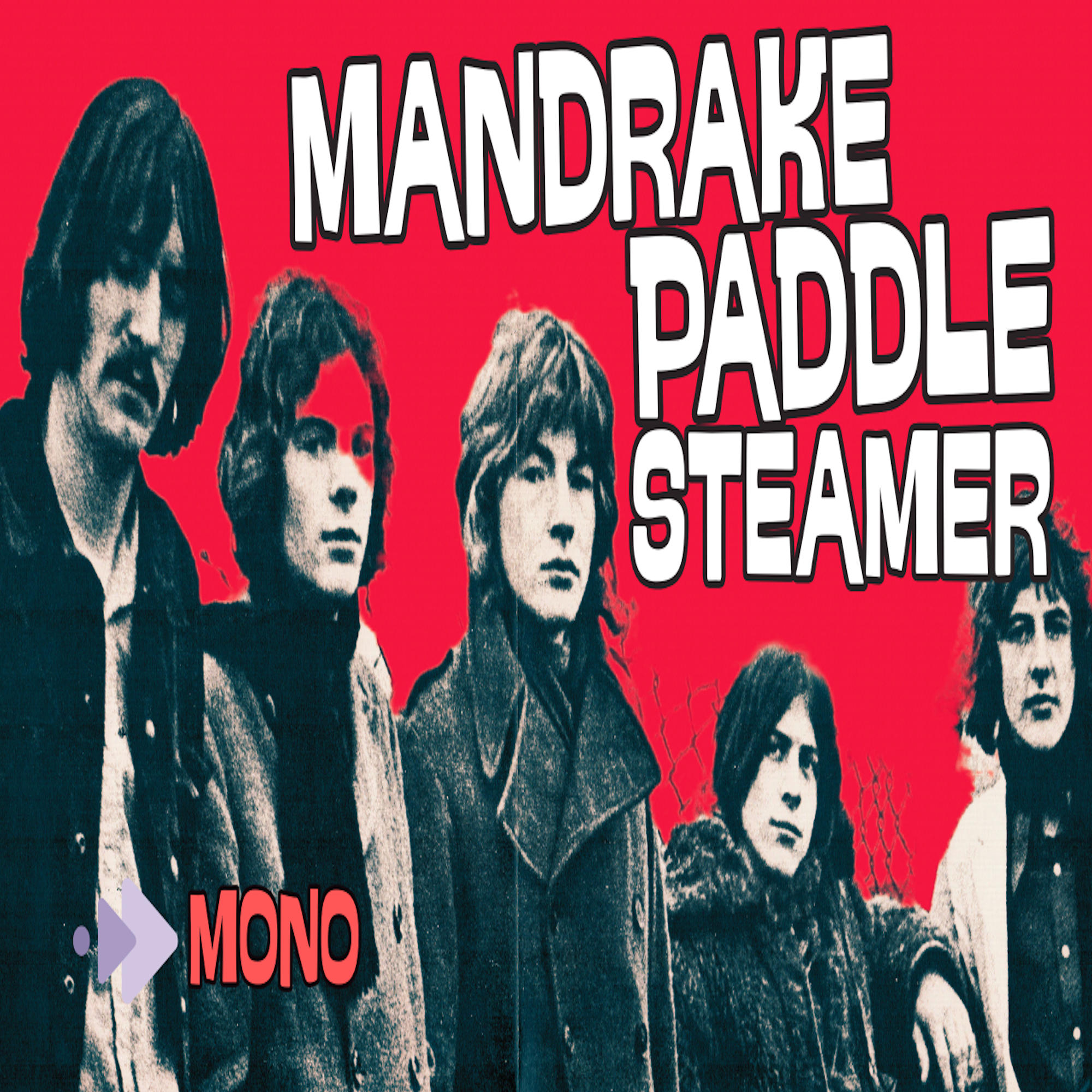
Mandrake Paddle Steamer | Strange Walking Man | (Parlophone) 1969 | MANDRAKE PADDLE STEAMER was Brian Engel (vocals), Martin Briley (lead guitar, vocals) Paul Riordan (bass), Martin Hooker (Farfisa organ) and Barry Nightingale (drums). The band was formed in 1968 when several of the above were London art school students, and becoming heavily influenced by the psychedelic music and hippie ethos then emerging from America’s West Coast.
They got together specifically to create an English version of the total music/lifestyle trip then being espoused by the new California scene, and were probably the first UK outfit to do so, rather than evolving (as did Pink Floyd and Dantalions Chariot, for instance) from existing blues, R & B or jazz bands.
Mandrake launched their own total concept ‘scene’ in the form of the Asgard club, which ‘happened’ every Sunday at the Angel Hotel, Stratford, in East London. In a freaked-out atmosphere, fiendishly illuminated by the Pale Green Limousine Light Show, the band and regular guests like Sam Apple Pie would play, and everybody would get heartily stoned.
A girl named Sue Ritter, who worked for Polydor Records, took one of their demo-taped songs, ‘October Country’, to that label’s Andy Black, who decided that it was a bit too way-out for Polydor. Undeterred, Sue then played it to Martin Wilcox of music publisher Shapiro Bernstein, and he was sufficiently impressed to invite Mandrake into a studio to make a set of demos of their original material.
Following some concerted plugging by Shapiro Bernstein and the band’s manager, East End businessman John Lindsay, Mandrake Paddle Steamer were eventually given an audition by EMI Records at Manchester Square. Brian Engel recalls that the EMI brass didn’t know what to make of them at all, but seemed sufficiently interested and/or bewildered to give the band a try. And thus it was that they were teamed with producer Rob Finnis and engineer Jeff Jarrett at Abbey Road studios, to make the single which you now hold in your hands.
Bam Caruso re-issue

‘Strange Walking Man’ was eventually released on EMI’s Parlophone label (R5780). It was one of the very first releases to be made on Abbey Road’s then-new 8-track equipment, and it had almost (at EMI’s request) featured studio session men playing the instrumental parts. The band had refused this, however, and had rehearsed hard to make sure they were not substituted for.
Manager John Lindsay apparently selected the titles for release, so it was presumably his decision to place an instrumental on the flip of the single, even though there were other Martin Briley/Brian Engel songs available. A point of interest is that the passages of music heard before and after the song on ‘Strange Walking Man’ are not Mandrake Paddle Steamer at all. These instrumental additions were Rob Finnis’ idea, and were lifted from a tape he had of some session musicians playing the Incredible String Band’s ‘Maybe Sunday’ (a song from their first album). Although only a snippet of a cover version backing track, it IS recognisable once you know!
What happened to Mandrake? They made several appearances on John Peel’s Top Gear radio show playing more of their own repertoire, and also featured in a totally forgotten movie entitled ‘Dream Of A World’, playing a decadent futuristic rock group! EMI, however, released no more records after ‘Strange Walking Man’.
A couple of years after the single, having broken up and then reformed minus Barry Nightingale, the band recorded an entire album of original material at AIR studios with Peter Sullivan and John Burgess, still unissued to this day (though the tapes still exist.) Former Tornado Clem Cattini was the drummer on this session. Through groups as diverse as Prowler, Pickettywitch, Starbuck, Greenslade, Limey, Ian Hunter’s band, Loudspeakers and the New Seekers, various former members of Mandrake have continued in the music business up to today.
Group bio:

The Mandrake Paddle Steamer started out from London’s East End and travelled everywhere on subjects as far apart as Viking folk-lore and Mad Garden Snails, depending on the musical aptitudes of Martin Briley (lead guitar, vocals) and Brian Engel (vocalist), who compose the bulk of the material the group performs. The remainder of the material is supplied by the considerable composing genius of Martin Hooker (keyboards), and Paul Riordan (bass guitar), injecting a bizarre beauty into the music, and the line-up is completed by Barry Nightingale, a drummer of considerable woomf.
The Mandrakes look only to their own resources for material and their music varies from loud, rhythmic songs, stamped with indelible riffs, on an amplified basis, to the poignant melodies and simple harmony of the acoustic music. It is a style of integral variety. But it remains a style, unmistakably, because like the Chameleon, the Mandrake Paddle Steamer has one heart, but many colours. The Mandrakes are very aware of other people’s boobs, consequently, there is a pleasing lack of pretence, both musically and lyrically.
All five, believe in the value of pure music forms, i.e. Blues, C & W and Folk. They realise that popular music is regarded as being a manufactured, money-raking media with little musical value, unlike Jazz, Blues and C & W, which seem to go on endlessly in a basically standardized form, and that generally speaking, Pop music is a contrived, meaningless, potentially saleable piece of plastic. For these reasons, the Mandrake Paddle Steamer seeks to mould it’s music into an accepted art form. No doubt the musically naive will continue to refer to them as a Pop group, but their sound will be pure music and pure songs, unaffected, and rarely predictable because the group doesn’t adhere, even in concert, to any one sound, trend or style of music.
Listen to the Mandrake Paddle Steamer and to hell with burgundy. Brian Engel – vocalist Martin Briley – lead guitar/vocals Martin Hooker – keyboards Paul Riordan – bass guitar Barry Nightingale – drums Agency – John Schofield 01-836 2899 Management – John Lindsay Record Label – Harvest (E.M.I.)
Briefly from Record Collector
THE MANDRAKE PADDLE STEAMERS The line-up of the Mandrake Paddle Steamers is confusing, with different sources citing different members, and some even suggesting that Robert “Addicted To Love” Palmer was in the band. He was in fact a member of a Yorkshire group called the Mandrakes, and the confusion arose because the second single by the Paddle Steamers was credited to Mandrake (in the singular) — but that only came out in Sweden.
The mainstays of our Mandrake were Brian Engel and Martin Briley, and their only UK single, “Strange Walking Man”, is another example of the psychedelic/progressive fusion which, by 1969, was yielding some very impressive results. The brief instrumental section tagged onto the end of the track, incidentally, is from another —untitled — Mandrake song. The B-side, “Steam”, is merely a heavy, but directionless, instrumental.
The single was recorded at Abbey Road and produced by Robert Finnis, a journalist who wrote for Let It Rock in the early 70s. The engineer was Robert John “Mutt” Lange, later to make his name as a producer. Mandrake’s Swedish single, the quieter “Sunlight Glide”/”Len” appeared shortly after their debut, and was included in the Swedish film, Skottet.
After the demise of the band, Engel and Briley turned up in the Parlophone act, Prowler, and subsequently Liverpool Echo, a 1973 pre-Rutles attempt to clone the Beatles’ sound using original songs. The latter’s sole LP on the Spark label was produced by Andrew Pryce Jackman, formerly of famed pop psychsters, the Syn. (Record Collector)
‘Skottet’

Our thanks go to Chris Backhage (from Mandrake Sweden) for sending us a tape of the Mandrake single and the photocopy of Paddle the sleeve; he told us about it last autumn, and upon hearing it we agreed that it was an important discovery. Steamer Chris caught the film ‘Skottet’ (‘The Shot’) on TV a while back and noticed that the name ‘Mandrake’ appeared in the closing credits. A while later he found a copy of ‘Sunlight Glide’ whilst record-hunting, and couldn’t believe his luck! What a superb 45 it is; the A-side is a slow, haunting song, and the B-side (‘Len’) is an atmospheric guitar-led instrumental that has more hooks than an angling society.
Two essential sides that really should be included on a decent compilation. Following this revelation we spoke to Paul Riordan (bassist with Mandrake Paddle Steamer) who kindly gave us some info on the Swedish single, and a lot more besides. As we’re a bit short on space this issue what follows is a resume of our conversation, but we hope to talk to Paul in more depth at a later date.
Top Gear
It transpires that ‘Skottet’ was probably only shown in Sweden; Paul told us that the film’s producers (Claes Fellbom and Calvin Floyd) also wrote the music and wanted the band to perform it. One of MPS’s original songs ‘Cooger And Dark’ was used in one scene where the ‘record’ is taken off the dansette and replaced with something Scandinavian: the ‘disc’ was in fact the session version from Peely’s Top Gear.
Ironically Brian Engel‘s voice is the one on ‘Cooger’ (as on ‘Strange Walking Man’), but he’d left the band prior to the film contract, and so Martin Briley is the vocalist on ‘Sunlight Glide’. Paul recently received the grand sum of 22p in royalties for the use of ‘Cooger And Dark’ in the film, and he hadn’t even written it! It was an Engel/Briley composition, and even more ironically the payment went straight to Paul via Brian – who is now head of the PRS (Performing Rights Society). Anyone who has bootlegged Mandrake Paddle Steamer, and thus ripped them off, would be well-advised to bear that in mind . . .
Paul also gave us the lowdown on the Top Gear session (It’s a shame that Nick G. is no longer with us – Ed.) that we mentioned above; five tracks were recorded for the BBC, but only four were broadcast. ‘Padded Cell’ (or ‘East Wing’ as it is variably called) was the one that didn’t go out over the airwaves: this was due to a disagreement between the group and the Corporation. The studio hands at the BBC slowed down various parts of the song in order to give it a ‘lunatic’ feel, and although Mandrake liked the end result, they felt that it shouldn’t have been done without first consulting the band.
After a heated exchange, the track was left ‘in the can’, however the track subsequently surfaced on the ‘unofficial’ Mandrake LP, as reviewed in 117 Issue 1. Apart from the Top Gear recording, Paul remembers the band doing a session at the Paris Theatre in London, for a Radio One Club programme hosted by Stuart Henry. Details of what songs were performed have sadly been lost in the mists of time; if anyone has any info, please write to us.
Dream Of A World

Readers in possession of the Bam Caruso reissue of ‘Strange Walking Man’ will already be aware that Mandrake made an appearance in a film called ‘Dream Of A World’; Paul told us that the band were filmed playing “one or two songs” in a West End club, watched by Rudolph Nuryev (famous ballet dancer, for our less cultured readers) amongst other celebrities. Apparently the movie was intended as a sequel to the controversial ‘War Games’ (that was banned – or ‘suppressed’ – for two decades) and dealt with the impending apocalypse, as seen through the eyes of decadent youth. (Sounds great! – Ed.) We will be delving deeper into this at a later date . . .
Our conversation with Paul turned towards the instruments and equipment used by the band, and I asked about amplification first; for those of you who care about such things, Selmer amps were originally favoured, though the band were later sponsored by Orange, and photographed with stacks of the distinctive jaffa-coloured gear, as well as gigging extensively with it.
What basses did Paul like? He replied that after using Hofner and Guild guitars he bought one of Danelectro’s unmistakeable ‘lyre’-shaped axes, and I said that I always thought (and still do) that they looked great. With a laugh in his voice, he said “Yeah, they looked great – but they sounded fucking awful!”
On that note, we returned to Mandrake; the group carried on for a couple of years after Brian had split, eventually ending up as a trio, with Dave Potts replacing drummer Barry Nightingale. Paul didn’t recall Clem Cattini (ex-Tornados percussionist) ever playing with the band, contrary to previous suggestions. After the ‘Pale Green Hmmm Driving Man’ single, issued under the name Prowler, things just fell apart, and Paul quit the music biz; however, he was “lured back” about six years ago, and spends his time composing and producing film music.
He remembers the Mandrake days with fondness, and is enthusiastic about fanzines and reissues dealing with sixties psych, which obviously came across during our chat. That aside, he’s content to live in the ’90s, and especially with the technological advances in sound equipment and recording techniques, DAT machines, etc. In fact he told us that he’d recently transferred “some old acetates” onto DAT to prevent them deteriorating any further: sounds very interesting – we’ll have to follow that up sane other time!
Thanks to Paul for his time, and for his encouragement: much appreciated. (117 fanzine, August 1992)


Leave a Reply